

Available on: PS4, PS5, Nintendo Switch, Xbox One, Xbox Series X/S, Microsoft Windows, macOS, Android
Played on: PS5
Originally released in 2020 on macOS, Switch and Windows, followed by PlayStation and Xbox releases in 2021, Hades is a roguelike set in the deepest depths of hell.
Playing as the son of Hades, Zagreus, the player must escape the Underworld, fighting Hades’ henchman along the way. Olympian Gods assist Zagreus on his journey, gifting boons which boost his powers and grant him additional talents for that particular run.
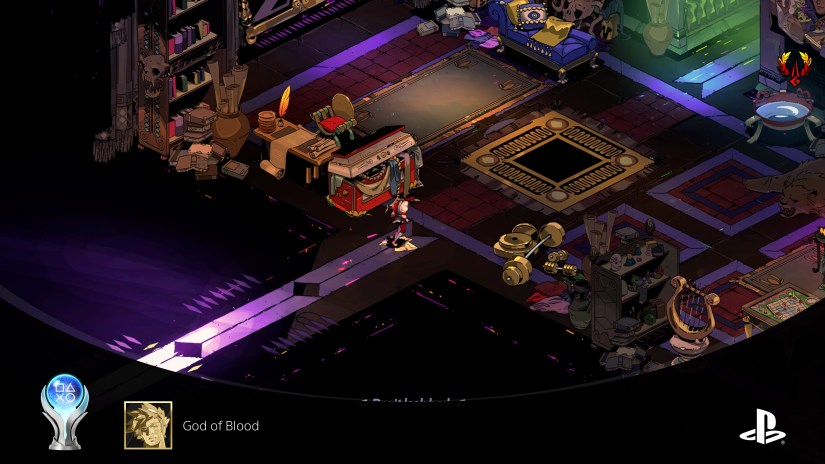
Playing in 2023, I was obviously late to Hades. I had a suspicion I’d like it as a longtime Greek Mythology nerd, and I’d seen so many cosplays of characters from it in my time so I knew I liked the character designs at least.
I wasn’t really sure what to expect from the gameplay going into Hades. People had told me the story was really fun, the characters were great, but I didn’t know a lot about the gameplay. Generally, I wouldn’t ever pick to play a roguelike but by the time I realised Hades was one, I’d already bought it, so I darn well was going to play it. And boy, am I glad I did.
If you have the misfortune of following me on Twitter then you’ll know how deep into Hades I got. For those who don’t, the answer is very deep. Characters on the cosplan list, figures ordered, fanart prints on the wall, fanfic reading deep.
For me, Hades just has everything I love in a game. A great story, well written characters, and a challenging game (perhaps too challenging at times, I’m not afraid to admit I turned on God Mode – a mode where every time you die you get 2% damage resistance added – very early on).
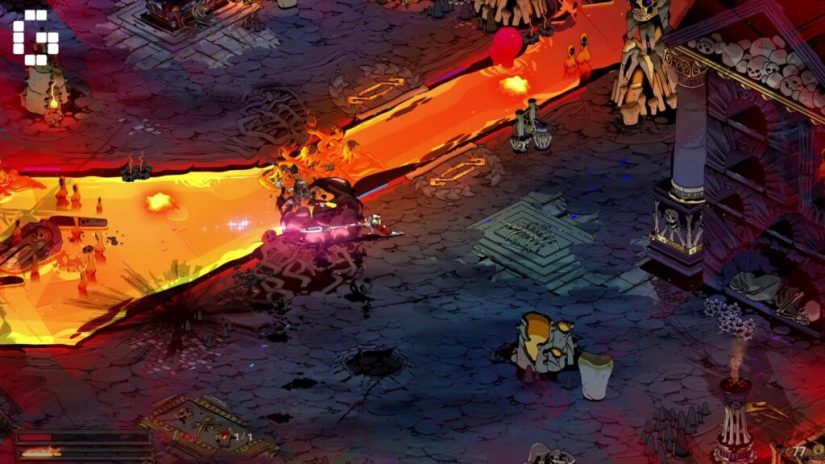
I loved how Zagreus’ motivations changed the more he found out about his family, and how the characters interacted with each other. Even dialogue which seemed like throwaway lines was witty, moving and recalled back to earlier moments. Everything felt so purposeful, and I was obsessed.
In Zagreus’ escape attempts he travels through four areas of the underworld; Tartarus, Asphodel, Elysium and the Temple of Styx. Each of these areas is made up of a series of chambers where battling through gets you effectively a prize at the end; this may be boons from the Olympian Gods, in game currency (Obols), darkness, gems. The ‘prize’ of each chamber is indicated on the door before you enter, so there is an element of choice in setting yourself up to receive certain items before you go in.
Zagreus unlocks 6 weapons throughout his escape attempts; a sword, a bow, a shield, a spear, and two which are effectively boxing gloves and a rapid fire gun. These weapons all have a primary and special attack, and you can ‘cast’ which is a long range attack. Collecting Olympian boons can power these up according to the God whose boon you have collected; Zeus’s boons are lightning based, Demeter’s are frost based, and so on. Through the escape attempts you’ll learn which boons you like, for me I’d always err towards Ares’ violent attacks and Artemis’ ‘call’ – a summon attack which charges up over the course of battle – was a particular favourite of mine.
Hades also has a social element to it. With the Olympian Gods, the Cthonic Gods and various other characters of note from Greek Mythology there are plenty of characters to talk to and get to know. There are also three love interests, with the possibility of a polyamorous relationship – though I only had eyes for Thanatos.
Hades feels like a triumph of compelling storytelling, unforgettable characters and challenging gameplay. Whilst I did find myself getting frustrated at dying in some parts, that really is the whole point of the game, and the motivation to push forward and unlock more of the story was greater than my desire to rage quit at points. Hades is so deceptively addictive; so many times I turned it on to “only do one run” and hours went by before I knew what had happened. It’s a real testament to the game that time flies by so quickly when playing.

I knew the platinum was going to be more time consuming than difficult, and it was. There’s no real stand out trophy in terms of difficulty, and if you’re heading towards the true end of the game then you will probably find that most trophies get unlocked on the way.
I played Hades for 78 hours, and although this is a long time, it really didn’t feel like it. I have played JRPG’s for 100+ hours, and they definitely felt every second of that time at some points, but when I saw how long I’d played Hades for it was definitely a surprise to learn it was this long.
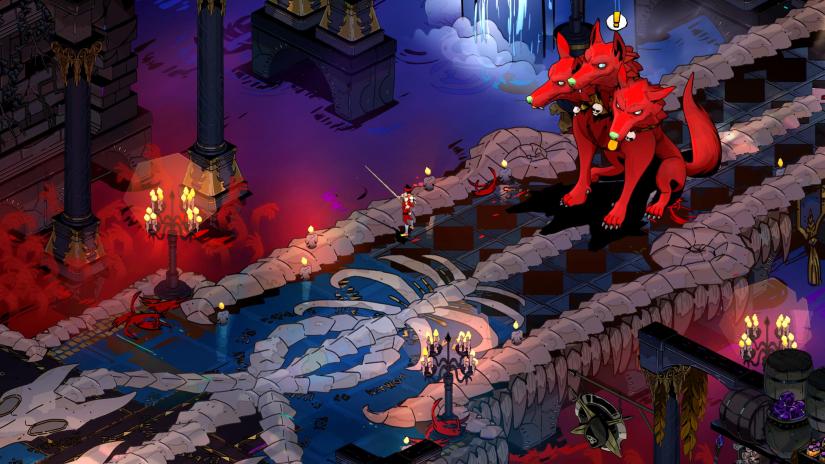
Trophy descriptions are fairly straightforward, but the thing that will probably take the most time is reaching 3 stars with every keepsake, and fulfilling the character specific prophecies as this is determinate on whether certain characters pop up in your run and there is no way to influence this.
Platinum difficulty rating:
 Culture Shack